


Official Website : https://divinenewz.com/
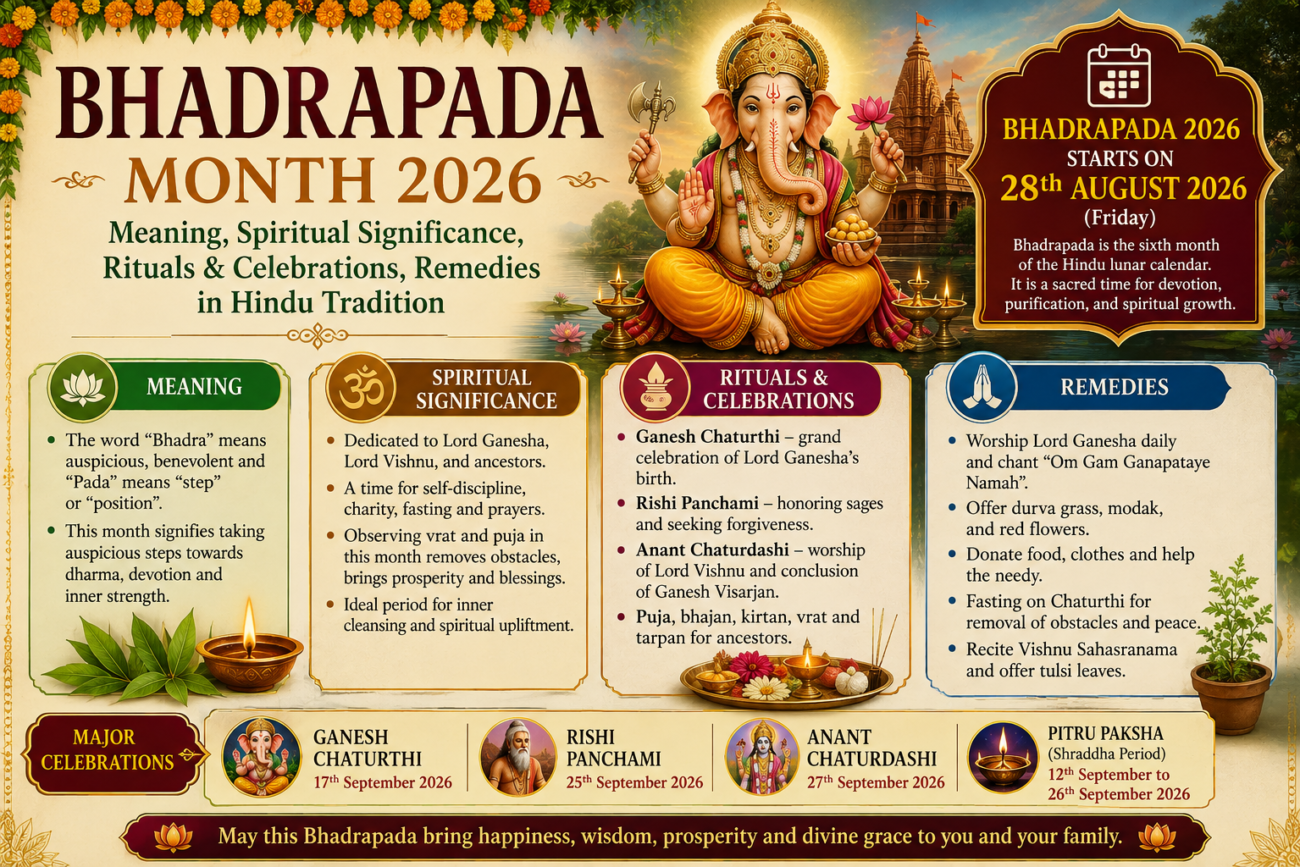
Bhadrapada month 2026, under the North Indian calendar prevalent in Punjab, Bhadrapad begins after Shravan Purnima (August 27 and 28), and the Bhadrapad Krishna Paksha begins on August 28. The major festivals of Bhadrapad continue till September, and end with Bhadrapad Purnima on September 26.
1. INTRODUCTION
Bhadrapada, also known as Bhado or Bhado, is one of the months with the most spiritual significance in the Hindu lunar calendar. The month is filled with devotion, fasting, sacred rituals, temple worship, family traditions, charity, and contemplation.
Bhadrapada is particularly significant because it marks the beginning of some of Hinduism’s most widely celebrated festivals, including Krishna Janmashtami, Hartalika Teej, Ganesh Chaturthi, Rishi Panchami, Radha Ashtami, Vamana Jayanti, Anant Chaturdashi, and Bhadrapada Purnima.
This month is particularly significant because it marks the beginning of several major Hindu festivals. These include
Krishna Janmashtami, Hartalika Teej, Ganesh Chaturthi, Rishi Panchami, Radha Ashtami, Vamana Jayanti, Anant Chaturdashi, and Bhadrapada Purnima. In the North Indian Purnimanta tradition, Bhadrapada begins immediately after Shravan Purnima, while in Amanta traditions the naming and boundaries of lunar months may differ. This distinction is important when discussing dates.
Because Hindu calendars are lunisolar and regional traditions use different month conventions, festival dates should always be checked against the local Panchang. The spiritual principles, however, remain broadly shared.
2. WHAT IS BHADRAPADA MONTH?
Bhadrapada is the sixth lunar month in the traditional Hindu calendar. The name is derived from Bhadrapada, which is also the name of two nakshatras: Purva Bhadrapada and Uttara Bhadrapada.
The month is traditionally understood through the movements of the Moon rather than the fixed dates of the Gregorian calendar. Consequently, Bhadrapada generally falls around August and September.
There are two major systems for defining Hindu lunar months:
- Purnimanta system: the month ends on Purnima, the full-moon day.
- Amanta system: the month ends on Amavasya, the new-moon day.
This is why the same festival can sometimes appear to belong to a different lunar month depending on the region or calendar system.
In North India, which includes Punjab and several neighboring regions, the Purnimanta system is traditionally important. According to the 2026 Punjab calendar, the major festivals of Bhadrapada include Kajari Teej on August 31, Krishna Janmashtami on September 4, Hartalika Teej and Ganesh Chaturthi on September 14, Rishi Panchami on September 15, Radha Ashtami on September 19, Parsva Ekadashi on September 22, Ganesh Visarjan and Anant Chaturdashi on September 25, and Bhadrapada Purnima on September 26.
Thus, Bhadrapada is not just a month in the calendar. It represents a long period of religious observance in which various forms of devotion gradually emerge.
3. WHY IS BHADRAPADA CONSIDERED SPIRITUALLY IMPORTANT?
The spiritual character of Bhadrapada can be understood through three broad themes:
devotion, purification and remembrance.
The month features festivals dedicated to the incarnations of gods and goddesses, but also includes rituals associated with repentance, self-restraint, remembrance of ancestors, and spiritual discipline.
The first half of the month is deeply associated with Krishna devotion. Janmashtami commemorates the appearance of Lord Krishna. After this, attention is focused on Ganesha, Parvati, sages, Radha, the Vamana form of Vishnu, and the divine element represented by Ananta.
This leads to remarkable spiritual progression.
A devotee may begin with love and devotion, move toward discipline and purification, cultivate wisdom and discrimination, and eventually arrive at remembrance of ancestors and impermanence.
Bhadrapada therefore provides an opportunity to reflect on several dimensions of Hindu spiritual life:
- Bhakti, or devotion
- Jnana, or knowledge
- Tapas, or disciplined effort
- Dana, or charity
- Seva, or service
- Smarana, or remembrance
- Prarthana, or prayer
- Dhyana, or meditation
- Pitru remembrance
- Respect for teachers, sages and ancestors
This is one reason the month is considered particularly suitable for people wishing to establish or renew a spiritual routine.
4. THE MEANING OF NAME BHADRAPADA
The Sanskrit name Bhadrapada is traditionally associated with ideas of auspiciousness, prosperity and sacredness. Interpretations of Sanskrit names can vary according to grammatical and traditional contexts, but the word carries a positive spiritual resonance.
The two nakshatras called Purva Bhadrapada and Uttara Bhadrapada are also connected with the name.
In traditional Hindu astrology and cosmology, nakshatras are lunar mansions that provide another layer of meaning to the movement of the Moon.
For ordinary spiritual practice, however, it is not necessary to become an expert in astrology to appreciate Bhadrapada. The month can simply be understood as a sacred period for turning one’s attention inward.
Its deeper message is:
Live with devotion, discipline, gratitude and awareness of the temporary nature of worldly life.
5. BHADRAPADA MONTH 2026: IMPORTANT DATES
For North Indian/Punjab traditions, the principal 2026 dates include:
| SR. NO. | DATES IN 2026 | FESTIVAL OR OBSERVANCE |
|---|---|---|
| 1. | AUGUST 29 | Bhadrapada begins, North Indian Purnimanta tradition |
| 2. | AUGUST 31 | Kajari Teej |
| 3. | SEPTEMBER 4 | Krishna Janmashtami |
| 4. | SEPTEMBER 7 | Aja Ekadashi |
| 5. | SEPTEMBER 14 | Hartalika Teej |
| 6. | SEPTEMBER 14 | Ganesh Chaturthi |
| 7. | SEPTEMBER 15 | Rishi Panchami |
| 8. | SEPTEMBER 16 | Balarama Jayanti |
| 9. | SEPTEMBER 17 | Vishwakarma Puja / Kanya Sankranti |
| 10. | SEPTEMBER 19 | Radha Ashtami |
| 11. | SEPTEMBER 22 | Parsva Ekadashi |
| 12. | SEPTEMBER 23 | Vamana Jayanti |
| 13. | SEPTEMBER 25 | Ganesh Visarjan |
| 14. | SEPTEMBER 25 | Anant Chaturdashi |
| 15. | SEPTEMBER 26 | Bhadrapada Purnima |
| 16. | SEPTEMBER 27 | Pitru Paksha begins |
These dates are based on the North Indian calendar framework reflected in the Punjab Panchang. Regional calendars may differ in the naming of the lunar month even when the festival itself falls on the same Gregorian date.
Bhadrapada Purnima in 2026 falls on Saturday, September 26. The Purnima tithi begins on September 25 and ends on September 26 according to the cited Panchang calculation.
6. SPIRITUAL SIGNIFICANCE OF FASTING IN BHADRAPADA
Fasting, or vrata, is a recurring practice during Bhadrapada.
Different people observe different levels of fasting depending on tradition, age, health, occupation and personal circumstances.
Fasting can include:
- complete fasting,
- fruit-based fasting
- one meal
- restricted foods,
- avoiding particular grains,
- or simply practicing restraint.
The deeper purpose of vrata is self-discipline.
The Sanskrit concept of vrata involves a deliberate spiritual resolve.
A person voluntarily places limits on ordinary habits in order to strengthen awareness.
This can transform fasting from a mere dietary activity into a spiritual practice.
Instead of thinking:
“I am not allowed to eat this.”
one can think:
“I am practicing mastery over my impulses.”
That distinction is important.
A fast should not become an unhealthy competition or source of pride.
The goal is greater clarity, devotion and self-control.
Anyone with dietary or medical limitations should not undertake restrictive fasting without appropriate professional advice.
7. DAILY PUJA DURING BHADRAPADA
A person does not need elaborate arrangements to observe Bhadrapada spiritually.
A simple daily routine can be enough.
Morning
Wake up early if possible.
Clean the body and living space.
Light a lamp before the household deity.
Offer water or flowers.
Sit quietly for a few minutes.
Chant a chosen mantra.
Read a small section of a sacred text.
During the day
Practice truthful speech.
Avoid unnecessary arguments.
Perform one’s duties sincerely.
Offer food mentally to God before eating.
Help another person if an opportunity arises.
Evening
Light a lamp.
Perform a short prayer.
Read or listen to a devotional story.
Practice gratitude.
Reflect on the day’s actions.
This kind of simple discipline is often more sustainable than an elaborate routine performed for only a few days.
8. RECOMMENDED MANTRAS DURING BHADRAPADA
Different traditions emphasize different deities, so there is no single mandatory mantra for the entire month.
For Lord Ganesha
“Om Gam Ganapataye Namah” and watch this video
Meaning: Salutations to Lord Ganesha.
For Lord Krishna
“Om Namo Bhagavate Vasudevaya”
This is a widely used Vaishnava mantra invoking Lord Vasudeva/Krishna.
For Lord Shiva
“Om Namah Shivaya”
A foundational Shiva mantra.
For Lord Vishnu
“Om Namo Narayanaya”
A traditional Vishnu mantra.
For Radha-Krishna devotion
Radhe Krishna
or devotional nama-sankirtana according to one’s tradition.
For general spiritual practice.
Gayatri Mantra
may be recited by those who have learned it according to their tradition.
The best approach is usually to choose one or two practices and perform them consistently rather than collecting many mantras without developing concentration.
9. BHADRAPADA REMEDIES IN HINDU TRADITION
The word “remedy” is often used in Hindu religious and astrological traditions for practices intended to cultivate
auspiciousness, reduce negative tendencies or seek divine grace.
These should be understood as traditional spiritual practices, not scientifically established treatments for medical, financial or psychological problems.
Remedy 1: Worship Ganesha
On Wednesdays,
Chaturthi or during Ganesh Chaturthi, offer:
- durva
- red flowers,
- fruits
- Modak
- and a lamp.
Chant:
“Om Gam Ganapataye Namah”
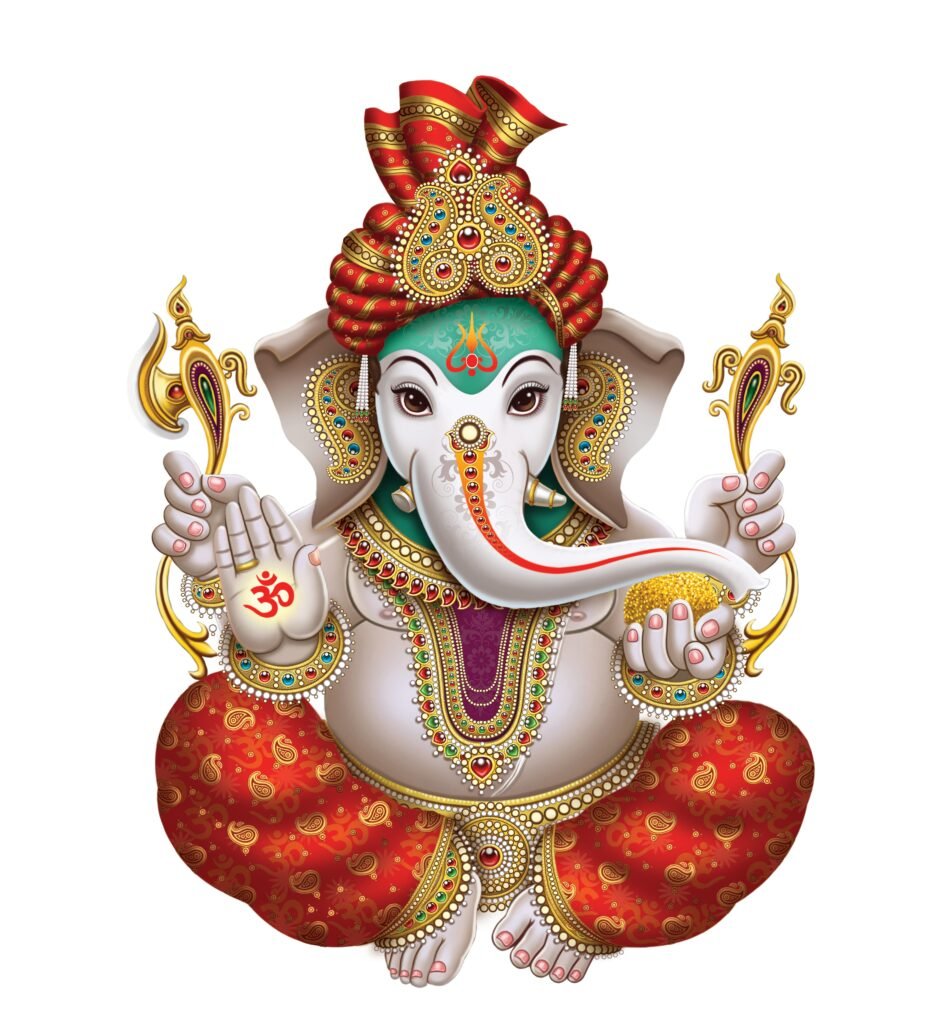
The spiritual intention is to cultivate wisdom and overcome inner obstacles such as anger, confusion, laziness and impulsiveness.
Remedy 2: Donate Food
Food donation is one of the simplest forms of dana. Offer food to:
- people in need
- monks or religious institutions,
- workers
- elderly people
- children
- or community kitchens.
The purpose is not merely to obtain a reward.
Dana weakens excessive attachment to possessions. It teaches:
What I have can also serve another person.
Remedy 3: Feed Animals Responsibly
Traditional Hindu practice places considerable value on compassion toward animals.
A person may provide suitable food or water for animals without disturbing wildlife or creating unhealthy dependence.
However, feeding should be responsible. Avoid foods that are harmful to the particular animal and avoid creating sanitation problems.
Remedy 4: Offer Water to Plants
Bhadrapada falls during the monsoon period in much of India, making it a natural time to develop respect for greenery and ecological life.
Planting trees, caring for plants and protecting water resources can become modern expressions of traditional reverence for nature.
Spirituality becomes more meaningful when reverence translates into responsible behavior.
Remedy 5: Practice Silence
Choose one period each day for silence. It might be:
- ten minutes,
- thirty minutes,
- or one hour.
During that time, avoid unnecessary conversation, entertainment and social-media consumption.
Sit quietly.
Observe the breath.
Repeat a mantra. This practice helps reduce mental noise.
Remedy 6: Read the Bhagavad Gita
Bhadrapada’s Krishna associations make it a particularly appropriate time for studying the Bhagavad Gita.
Even reading one verse or a few paragraphs daily can become a meaningful practice.
Rather than merely completing chapters, ask:
How can this teaching change my behavior today?
For example, the Gita’s teachings on detached action can be applied to work.
Its teachings on equanimity can be applied to success and failure.
Its teachings on devotion can be applied to gratitude.
Its teachings on dharma can be applied to responsibility.
Remedy for Mental Restlessness: Nama Japa
One of the simplest traditional remedies for a restless mind is nama japa, repetition of a divine name.
Choose a name appropriate to one’s tradition:
- Rama
- Krishna
- Shiva
- Narayana
- Ganesha
- Devi
Repeat it slowly.
The practice gives the mind one object of attention. For example:
Om Namo Bhagavate Vasudevaya
may be repeated 108 times.
The number 108 is traditional in many Hindu practices, but a person may choose a smaller number if necessary.
Consistency matters more than quantity.
10. CHARITY DURING BHADRAPADA
Charity, or dana, is repeatedly emphasized in Hindu spiritual traditions. During Bhadrapada, devotees may donate:
- food
- clothing
- educational materials
- medicines through legitimate charitable organizations,
- books
- household essentials
- or financial assistance.
The key is to give appropriately and respectfully. Charity should preserve the dignity of the recipient.
A good principle is:
Give without humiliating the person who receives.
Dana is spiritually valuable because it challenges possessiveness.
It asks the individual to recognize that wealth has a social dimension.
11. WHAT SHOULD BE AVOIDED DURING BHADRAPADA?
There is no single universal list of prohibitions for every Hindu community. Rules vary by sampradaya, region, family tradition and individual vrata. Nevertheless, many devotees intentionally reduce:
- intoxicants
- excessive eating
- anger
- gossip
- dishonesty
- unnecessary arguments,
- wastefulness,
- cruelty,
- and excessive entertainment.,
Some traditions prescribe particular dietary restrictions during specific vratas.
These should be followed according to the relevant Panchang and family or sampradaya tradition rather than assuming that every rule applies to every Hindu.
The guiding principle is:
Reduce tamasic and distracting habits and increase sattvic practices.
12. SATTVIC LIVING DURING BHADRAPADA
Sattva is traditionally associated with clarity, balance and harmony. A sattvic lifestyle may include:
- fresh food
- moderation
- cleanliness
- prayer
- meditation
- peaceful speech,
- compassion,
- study,
- and sufficient rest.
It is not necessary to make extreme lifestyle changes.
Instead, gradually introduce greater order.
For example:
Morning: prayer and meditation.
Day: honest work and service.
Evening: scripture reading and gratitude.
Night: peaceful reflection instead of excessive stimulation.
This simple rhythm can make the month spiritually meaningful.
13. BHADRAPADA FOR SPIRITUAL BEGINNERS
A beginner does not need to observe every festival.
Choose three commitments:
Commitment 1: Daily mantra
Chant one mantra for 5–10 minutes.
Commitment 2: Daily reading
Read a short passage from the Bhagavad Gita or another trusted spiritual text.
Commitment 3: Weekly charity
Perform one act of service or donation each week.
These three practices are enough to make Bhadrapada spiritually meaningful.
14. THE DEEPER MESSAGE OF BHADRAPADA
A beginner does not need to observe every festival. It is a way of relating to life.
Krishna teaches wisdom in action.
Ganesha teaches intelligence and removal of obstacles.
Parvati teaches determination.
The sages represent knowledge.
Radha represents devotion.
Vamana teaches humility.
Ananta represents the Infinite.
Ganesh Visarjan teaches impermanence.
Pitru Paksha teaches gratitude toward ancestors.
Taken together, these teachings form a coherent spiritual philosophy.
Use intelligence.
Perform your duties.
Practice devotion.
Respect knowledge.
Control the ego.
Give generously.
Remember your ancestors.
Accept impermanence.
Accept impermanence.
Seek the eternal.
15. CONCLUSION
Bhadrapada is much more than a month filled with Hindu festivals. It is a period in which different spiritual teachings come together. Krishna Janmashtami teaches devotion, wisdom and dharma. Hartalika Teej represents determination, faith and tapasya. Ganesh Chaturthi teaches wisdom, auspicious beginnings and the removal of inner obstacles. Rishi Panchami reminds us to respect knowledge and the sages who preserved it. Radha Ashtami represents the depth of divine love and bhakti. Vamana Jayanti teaches humility and surrender. Anant Chaturdashi points toward the Infinite. Ganesh Visarjan teaches impermanence and the importance of releasing attachment. Bhadrapada Purnima provides an opportunity for prayer, charity and reflection. And the transition into Pitru Paksha reminds us of gratitude toward ancestors and previous generations.
16. WRAPPING UP
For 2026, the North Indian/Punjab calendar places these observances in a particularly concentrated sequence: Janmashtami on September 4, Hartalika Teej and Ganesh Chaturthi on September 14, Rishi Panchami on September 15, Radha Ashtami on September 19, Vamana Jayanti on September 23, Ganesh Visarjan and Anant Chaturdashi on September 25, and Bhadrapada Purnima on September 26.
Bhadrapada invites the devotee to move from ritual toward realization, from desire toward discipline, from attachment toward surrender, and from self-centeredness toward service.
When observed with sincerity, the month can become a period of profound inner renewal.
For exact puja muhurta, fasting times, tithi endings, moonrise and parana timings, devotees should consult a location-specific Panchang because these details depend on geographical location and the calendar tradition being followed. The dates in this article are specifically presented using the North Indian/Punjab framework.
Bhadrapada 2026 is therefore not simply a season of festivals. It is an invitation to cultivate wisdom, devotion, discipline, humility, compassion and gratitude—and to carry those qualities beyond the month itself.
You still have any question, feel free to ask me via comments or via email.
Don`t forget to share what you like here on
Youtube,
Facebook, Instagram with your friends and family.
At DivineNewz, a spiritual and temples news related information providers, is working on the project to work for religion and information about the temples to share with you to bring new ideas about spiritual and religious world.
If you want article on any hundu religion specific topic then post the comment i will write on that topic.
Get in touch with DivineNews by contacting by divinenewz6@gmail.com/ For more information, please visit:
https://www.divinenewz.com
ARTICLE WRITTEN BY:
Divinenewz is a firm Working very proficiently for sharing the divinely knowledge, darshan and pilgrim details and many more in spiritual field. If you have any unique temple and divine place around the globe, then contact us at divinewisdom0608@gmail.com, divinenewz6@gmail.com, or
For more information, please visit:
https://www.divinenewz.com
Follow Us :
1. FACEBOOK: Click Here…..
2. YOUTUBE: Subscribe & Share…..
3. WHATSAPP CHANNEL: Join & Share…..
-
When does Bhadrapada month begin in 2026?
In the North Indian Purnimanta tradition used in Punjab, Bhadrapada begins after Shravana Purnima, with Bhadrapada Krishna Pratipada beginning on August 29, 2026. Calendar conventions differ across India, so the month may be labeled differently in Amanta calendars.
-
When does Bhadrapada month end in 2026?
In the North Indian Purnimanta framework, Bhadrapada concludes with Bhadrapada Purnima on September 26, 2026. Pitru Paksha begins the following day in the cited Punjab calendar.
-
When is Krishna Janmashtami in 2026?
Krishna Janmashtami is observed on September 4, 2026 in the cited Punjab/North Indian calendar.
-
When is Bhadrapada Purnima in 2026?
Bhadrapada Purnima is on September 26, 2026 in the cited North Indian calendar.
-
When does Pitru Paksha begin in 2026?
In the cited Punjab/North Indian calendar, Pitru Paksha begins on September 27, 2026, immediately following Bhadrapada Purnima.
-
Which deity is worshipped during Bhadrapada?
There is no single deity exclusively associated with the entire month. Major observances honor Krishna, Ganesha, Parvati, Radha, Vishnu, Vamana and Ananta, while Rishi Panchami honors the sages.
-
Is Bhadrapada an auspicious month?
Bhadrapada contains many highly important religious observances and is considered spiritually significant in Hindu traditions. However, whether a particular day is suitable for a particular activity depends on the tithi, nakshatra, local Panchang and the nature of the activity.
-
Can unmarried women observe Hartalika Teej?
Yes. In traditions where unmarried women observe Hartalika Teej, the vrata may be undertaken with prayers for a suitable life partner. Customs vary by region and family tradition.
-
Is fasting compulsory during Bhadrapada?
No. Fasting practices vary according to the festival, family tradition and individual circumstances. People who cannot fast can observe the festival through prayer, charity, mantra, meditation or service.
-
What is the best mantra for Bhadrapada?
There is no single best mantra for everyone. For Ganesha worship, Om Gam Ganapataye Namah is widely used. For Krishna/Vishnu devotion, Om Namo Bhagavate Vasudevaya and Om Namo Narayanaya are traditional choices.
-
What is the best Bhadrapada remedy for removing obstacles?
A traditional approach is Ganesha worship with mantra japa, prayer, charity and disciplined action. The practical side is equally important: identify the obstacle, make a plan and take consistent action.
-
What should I avoid during Bhadrapada?
Practices vary, but many devotees intentionally reduce anger, dishonesty, gossip, excessive indulgence, intoxicants and unnecessary conflict. Specific dietary restrictions should be followed according to one’s own tradition.
-
Is Ganesh Visarjan compulsory?
The traditional festival culminates in Visarjan, but the precise ritual form varies. If performing immersion, environmentally responsible methods should be used.
-
Is Bhadrapada good for starting spiritual practice?
Yes. Its numerous devotional observances make it an excellent opportunity to establish a daily routine of prayer, japa, meditation, scripture reading and charity.
-
What is the deepest message of Bhadrapada?
The month can be understood as a journey toward devotion, wisdom, discipline, humility, charity, gratitude and detachment.
-
When does Bhadrapada month begin in 2026?
In the North Indian Purnimanta tradition used in Punjab, Bhadrapada begins after Shravana Purnima, with Bhadrapada Krishna Pratipada beginning on August 29, 2026. Calendar conventions differ across India, so the month may be labeled differently in Amanta calendars.
-
When does Bhadrapada month end in 2026?
In the North Indian Purnimanta framework, Bhadrapada concludes with Bhadrapada Purnima on September 26, 2026. Pitru Paksha begins the following day in the cited Punjab calendar.
-
When is Krishna Janmashtami in 2026?
Krishna Janmashtami is observed on September 4, 2026 in the cited Punjab/North Indian calendar.
-
When is Bhadrapada Purnima in 2026?
Bhadrapada Purnima is on September 26, 2026 in the cited North Indian calendar.
-
When does Pitru Paksha begin in 2026?
In the cited Punjab/North Indian calendar, Pitru Paksha begins on September 27, 2026, immediately following Bhadrapada Purnima.
-
Which deity is worshipped during Bhadrapada?
There is no single deity exclusively associated with the entire month. Major observances honor Krishna, Ganesha, Parvati, Radha, Vishnu, Vamana and Ananta, while Rishi Panchami honors the sages.
-
Is Bhadrapada an auspicious month?
Bhadrapada contains many highly important religious observances and is considered spiritually significant in Hindu traditions. However, whether a particular day is suitable for a particular activity depends on the tithi, nakshatra, local Panchang and the nature of the activity.
-
Can unmarried women observe Hartalika Teej?
Yes. In traditions where unmarried women observe Hartalika Teej, the vrata may be undertaken with prayers for a suitable life partner. Customs vary by region and family tradition.
-
Is fasting compulsory during Bhadrapada?
No. Fasting practices vary according to the festival, family tradition and individual circumstances. People who cannot fast can observe the festival through prayer, charity, mantra, meditation or service.
-
What is the best mantra for Bhadrapada?
There is no single best mantra for everyone. For Ganesha worship, Om Gam Ganapataye Namah is widely used. For Krishna/Vishnu devotion, Om Namo Bhagavate Vasudevaya and Om Namo Narayanaya are traditional choices.
-
What is the best Bhadrapada remedy for removing obstacles?
A traditional approach is Ganesha worship with mantra japa, prayer, charity and disciplined action. The practical side is equally important: identify the obstacle, make a plan and take consistent action.
-
What should I avoid during Bhadrapada?
Practices vary, but many devotees intentionally reduce anger, dishonesty, gossip, excessive indulgence, intoxicants and unnecessary conflict. Specific dietary restrictions should be followed according to one’s own tradition.
-
Is Ganesh Visarjan compulsory?
The traditional festival culminates in Visarjan, but the precise ritual form varies. If performing immersion, environmentally responsible methods should be used.
-
Is Bhadrapada good for starting spiritual practice?
Yes. Its numerous devotional observances make it an excellent opportunity to establish a daily routine of prayer, japa, meditation, scripture reading and charity. -
What is the deepest message of Bhadrapada?
The month can be understood as a journey toward devotion, wisdom, discipline, humility, charity, gratitude and detachment.
