


Official Website : https://divinenewz.com/
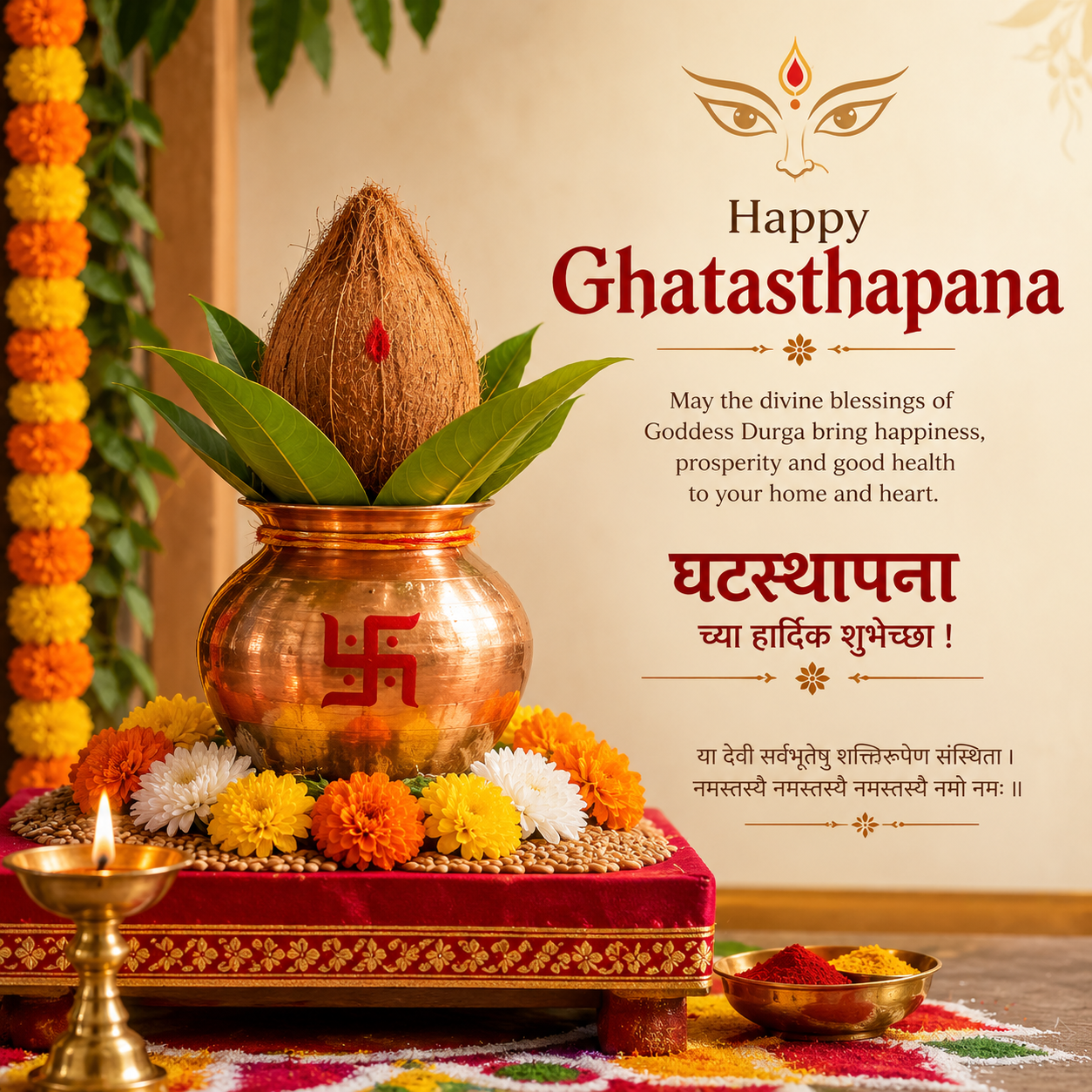
Ghatasthapana is one of the most important rituals performed at the beginning of Navratri. Navratri is a nine-night Hindu festival dedicated to the worship of Goddess Durga and her various forms. Also known as Kalash Sthapana, this sacred ceremony marks the formal beginning of Navratri worship in many Hindu traditions.
|
IMPORTANT :
|
TABLE OF CONTENT |
1. INTRODUCTION
The word
Ghatasthapana is derived from two Sanskrit words:
ghata, meaning sacred pot or vessel, and
Sthapana, meaning installation or consecration. During this ritual, a sacred Kalash is installed at the place of worship and is considered a symbol of divine energy, abundance, fertility, purity, and auspiciousness.
Ghatasthapana is especially important during Sharad Navratri, which is celebrated in the Hindu month of Ashvin, usually in September or October. Devotees install Kalash, sow barley or other sacred grains, invoke Goddess Durga and perform prayers, fasting, meditation and spiritual rituals for nine days.
But Ghatasthapana is much more than simply placing a pot on the puja altar. It symbolizes inviting divine consciousness into one’s home and life. This ritual represents the beginning of an inner spiritual journey in which devotees receive the blessings of Shakti, the divine feminine power.
2. WHAT IS GHATASTHAPANA?
Ghatasthapana is a ritual of installing a sacred Kalash at the beginning of Navratri. Traditionally, the Kalash is filled with water and decorated with auspicious items such as mango leaves and coconuts. It is placed on a prepared earthen bed in which barley or other grains are sown.
The kalash is worshipped as a sacred manifestation of divine energy. In many traditions, devotees invoke Goddess Durga or the universal Shakti into the kalash and surrounding worship space.
This ritual may vary slightly depending on the region, family tradition, and religious lineage. In some homes, the Kalash is installed along with an idol of Goddess Durga. In others, a sacred lamp, grains, and other symbols of prosperity and fertility are also part of the ritual.
Ghatasthapana therefore serves two purposes:
- It marks the beginning of Navratri worship.
- It creates a sacred space for prayer, devotion and spiritual discipline.
This ritual is traditionally performed at an auspicious time called Ghatasthapana Muhurta. Many devotees choose the time determined by the local Hindu calendar.
3. WHY IS GHATASTHAPANA PERFORMED DURING NAVRATRI?
Navratri is traditionally associated with the worship of Shakti, the divine feminine power responsible for creation, preservation and transformation.
According to Hindu traditions, Goddess Durga symbolizes the triumph of divine power and righteousness over destructive forces. The nine nights are associated with various forms of the Goddess, and devotees use this period for prayer, fasting, meditation, and spiritual purification.
Ghatasthapana lays the sacred foundation for these nine days.
The Kalash can be symbolically understood as a symbol of the universe. The water contained within it represents life-giving power, while the leaves, coconut, and other elements represent fertility, growth, and prosperity.
By installing the Kalash, devotees express wishes such as the following:
So, Ghatasthapana is not merely a ceremonial act. It is a spiritual declaration that the devotee is beginning Navratri with devotion and commitment.
4. RELIGIOUS SIGNIFICANCE OF THE KALASH
The Kalash holds an important place in Hindu worship. It is commonly associated with purity, auspiciousness, prosperity, and divine presence.
The Kalash is filled with clean water and decorated with few sacred objects. In many traditions, a coconut is placed on top, surrounded by mango leaves.
Each object has its own symbolic meaning.
i. The Kalash
The pot represents the vessel of life and divine energy. It can also symbolize the human body, which is considered the vessel of consciousness.
ii. Water
Water represents life, purification and the flow of divine energy. Since all living beings depend upon water, it is naturally associated with fertility and sustenance.
iii. Mango Leaves
Mango leaves are considered auspicious in Hindu rituals and are associated with life, growth, freshness, and prosperity.
iv. Coconut
The coconut is a common offering in Hindu worship. Its three characteristic markings are sometimes symbolically associated with divine aspects, while the coconut itself represents purity, self-surrender and auspiciousness.
v. Grains
In many traditions, barley or other grains are sown during Ghatasthapana. Their growth over nine days symbolizes fertility, prosperity, new life, and the gradual development of spiritual consciousness.
5. WHAT IS THE SIGNIFICANCE OF BARLEY SOWING?
One of the most recognizable aspects of Ghatasthapana is the sowing of barley seeds (jau).
The place of worship is cleaned, a little soil is added, and barley seeds are sown. The seeds are watered regularly and allowed to germinate during Navratri.
The growing shoots are traditionally known as Jaware, barley sprouts, or Navaratri barley sprouts, depending on regional usage.
Their growth carries a powerful symbolic message.
A seed appears small and lifeless, yet it sprouts when sown and watered in fertile soil. Similarly, spiritual progress may begin with a small act of faith and discipline, but develops gradually through sustained effort.
Therefore, barley sprouts symbolize:
- Growth
- Fertility
- Prosperity
- Renewal
- Life
- Hope
- Spiritual development
In some traditions, the growth of the barley is also observed as part of the concluding Navratri rituals.
6. HOW IS GHATASTHAPANA PERFORMED?
The exact procedure varies across communities, but a traditional Ghatasthapana ceremony usually involves the following steps.
Step 1: Clean the Worship Area
The area where the kalash will be installed is thoroughly cleaned. Devotees may decorate the space with rangoli, flowers and other auspicious symbols.
Cleanliness is traditionally regarded as an important part of preparing a sacred space.
Step 2: Prepare the Soil
A clean container or wooden platform is prepared. Soil is placed inside it, and barley seeds are sown. The soil represents the earth and the fertile foundation from which life grows.
Step 3: Prepare the Kalash
A clean copper, brass or earthen pot may be used depending on family tradition. The kalash is filled with clean water. Some traditions add sacred substances such as rice, coins, grains or other auspicious items.
Step 4: Decorate the Kalash
Mango leaves are traditionally arranged around the opening of the pot.
A coconut, often wrapped or decorated with red or yellow cloth, is placed on top.
The kalash may also be decorated with sacred thread, vermilion, sandalwood paste or other traditional materials.
Step 5: Invoke the Deities
Mantras and prayers are recited to invoke divine blessings. Goddess Durga or Shakti is worshipped as the central divine presence of Navratri.
Some traditions also invoke Ganesha, the Navagrahas, the sacred rivers and other deities before beginning the principal worship.
Step 6: Light a Diya
A sacred lamp is lit. The flame represents divine light, knowledge and the removal of spiritual darkness.
The lamp may be kept burning throughout Navratri in households that follow the tradition of an uninterrupted Akhand Jyoti.
Step 7: Perform Sankalpa
The devotee makes a sankalpa, or sacred intention, for the Navratri observance. The sankalpa may express the intention to worship Goddess Durga, observe fasting, perform daily prayers or seek spiritual well-being for oneself and one’s family.
Step 8: Offer Prayers and Naivedya
Flowers, fruits, sweets, incense and other traditional offerings are presented to the Goddess.
The specific offerings vary by region and family tradition.
7. WHAT IS THE BEST TIME FOR GHATASTHAPANA?
The timing of Ghatasthapana is traditionally considered important.
It is generally performed on Pratipada, the first day of Navratri, during an auspicious period determined according to the Hindu Panchang.
Traditionally, devotees prefer an appropriate Ghatasthapana Muhurat rather than choosing an arbitrary time.
The exact date and time change every year because Hindu festivals follow the lunar calendar and local sunrise calculations.
Therefore, devotees should consult a reliable local Panchang, temple authority or knowledgeable priest for the exact Ghatasthapana Muhurat for their location and year.
8. WHY IS GHATASTHAPANA CONSIDERED IMPORTANT?
Ghatasthapana has several layers of spiritual significance.
